Tuesday, April 29, 2008

Downtown Excursion

In the Driskill...

On Wednesday April 23 Cat and I took an excursion downtown because we could not make the field trip. We both live in West Campus so the walk to the Capitol Building was a short and easy one. We identified with Ancient Greece upon arrival when we saw the examples of Doric, Ionic and Corinthian columns both inside and outside of the building.

[1]Ionic column on rotunda of Capitol just below top layer of dome next to windows and Corintian columns under Ionics.

Doric Column on North entrance.

Once we documented all of the columns Cat and I headed to the center of the building, under the illustrious dome. Unfortunately, we could not get right under the dome because a group of braces-wearing middle school students were monopolizing the area. But the effect was still dazzling nonetheless. Photo of Cat and me under the dome area. As I lay there, looking up into the eternal perfection of the dome shape, I could not help but to become lost in the dome’s trance. The rotunda, just as that of the Pantheon and St. Peter’s Basilica, seemed to be beckoning to the heavens. Perhaps it was built to symbolize the heavenly rays of justice and compassion that are (supposed) to be shed upon lawmakers. I must admit that I was a tad jealous…the LA Capitol is a building much like the tower and needless to say, without a rotunda. Photo of Texas Capitol dome.

[2] The Roman Pantheon.

[3] St. Peter's Basilica, Rome.

We then headed out of the Capitol to the Old General Land Office Building, which is now the visitor’s center. There we saw Star of David window frames which connected us to ancient Israel. Cat and I in front of bldg. The Star of David window frames.

The beautiful St.Mary’s Cathedral was next on the list and it’s Gothic architecture was immediately apparent on its exterior. The exterior exhibited Ruskin’s second principle of “The Nature of Gothic.” The building “did not say the same thing over and over again,”[4] but was composed of all different design schemes. On the left was a wide and tall bell tower and on the right, a shorter and skinnier tower. Additionally, the rose window contrasted with the more vertical windows on the rest of the exterior. Me in front of church. Large bell tower.Unfortunately, we could not visit the interior of the church due to a funeral(see hearse in previous photo).

Next it was off to the Driskill Hotel. Along the way we passed by a few more Victorian buildings. Me in front of Victorian buildings. The Driskill is certainly the grande dame of Victorian architecture in Austin. The building’s size and its preservation are magnificent. It was easy to notice Ruskin’s fourth principle of “disturbed imagination.” The outside is strange to comprehend at first, it does not make any sense. There are windows off all shapes and sizes as well as arches which are curved and pointy but it is this ludicrous design that makes the building so unique. The outside of the Driskill.he inside is fantastic as well. The lobby appears to be a large vault with towering pillars. Photo of me inside Driskill at top of blog. The interior is home to the “Widow Maker.” It is a statue where a cowboy is caught in part of his saddle and dragged to his death. [5] The “Widow Maker” statue.


[1] All photos, unless otherwise stated, are from my own collection.

[2] http://www.crystalinks.com/romepantheon.html

[3] http://www.essential-architecture.com/STYLE/412px-StPetersDomePD.jpg

[4] Victorian Lit Course pack, 535.

[5] http://www.thetyphoon.net/~ddiepo/photo_lg.php

Monday, April 21, 2008

Jungle book

Kipling’s Jungle Books were extremely didactic and uplifting. I especially enjoyed the differences between man and animal in “The Miracle of Purun Bhagat” and “Red Dog.” The relationships between man and beast as well as one in relation to the other are very transient in both tales.

In “Red Dog” Mowgli exclaims, “Nay, nay, I am a wolf…It is no will of mine that I am a man.”[1] in response to Akela’s assertion that he is a man. It is also important to notice that although Akela acknowledges that Mowgli is human, he also calls the boy “Little Brother.”[2] This shows how close the wolf feels to the young boy although he is human. Akela is not the only one who classifies Mowgli as human. Kaa does as well, when he hears of Mowgli’s erred plan saying, “That is Man’s [sic] talk and Man’s [sic] cunning.”[3]

[4]Mowgli and Kaa.

Mowgli does admit he is a man but “in my stomach that this night I have said that I am a Wolf [sic]. I called the River and the Trees [sic] to remember.”[5] But his claim to being a wolf this night is undermined as Kipling describes how Mowgli liked to “make the Jungle know that he was their overlord.”[6] Additionally, his actions highlight the boy’s human nature. Mowgli’s initial attitude to overcome the dhole is immature and overzealous. It is not until Kaa, an animal, is able to reason with the boy that Mowgli comes to his senses. Kaa is also the genius behind the great plan to kill the dhole, which is successful, using Africanized honeybees.

[7] An Africanized honeybee.

Bhagat’s relationship with animals is the opposite of Mowgli’s. Instead of loudly defending his parallelism to animals and nature he becomes one with them without even opening his mouth. Also, instead of being taught, he becomes a teacher. The people of the village learn from his example of heroism and silent leadership. Over time the people grow to respect this man who has the ability to charm nature without even trying. At first “the wild things, who knew Kali’s Shrine well, came back to look at the intruder.”[8] But over time, trust grew between the hermit and the animals and “At last, the musk-deer, the shyest and almost the smallest of the of the deerlets, came, too.”[9]

[10]Man and beast as one.

Bhagat’s final act of heroism came from a final act of selflessness, he saved the people of the village from a volcano such as the one below. [11] Mowgli’s connection to animals is one of loud and boastful student, while the Bhagat represents the silent, powerful teacher.


[1] Kipling, Rudyard. 1992. The Jungle Books. New York: Oxford University Press, 300.

[2] Kipling, 300.

[3] Kipling, 290.

[4] http://www.filmstreet.co.uk/uploads/images/Jungle_Book_Mowgli_Kaa_657.jpg

[5] Kipling, 285.

[6] Kipling, 291.

[7] http://www.brainfleas.com/WindowsLiveWriter/AvianFluCarryingKillerBeessettoInvadeCot_955A/image%7B0%7D_thumb%5B1%5D.png

[8] Kipling, 175.

[9] Kipling, 176.

[10] http://www.graingertv.com/content_images/2/w_beast_within_334x249.jpg

[11] http://youtube.com/watch?v=OowFvnlWI90&feature=related

Jungle book

Kipling’s Jungle Books were extremely didactic and uplifting. I especially enjoyed the differences between man and animal in “The Miracle of Purun Bhagat” and “Red Dog.” The relationships between man and beast as well as one in relation to the other are very transient in both tales.

In “Red Dog” Mowgli exclaims, “Nay, nay, I am a wolf…It is no will of mine that I am a man.”[1] in response to Akela’s assertion that he is a man. It is also important to notice that although Akela acknowledges that Mowgli is human, he also calls the boy “Little Brother.”[2] This shows how close the wolf feels to the young boy although he is human. Akela is not the only one who classifies Mowgli as human. Kaa does as well, when he hears of Mowgli’s erred plan saying, “That is Man’s [sic] talk and Man’s [sic] cunning.”[3]

[4]Mowgli and Kaa.

Mowgli does admit he is a man but “in my stomach that this night I have said that I am a Wolf [sic]. I called the River and the Trees [sic] to remember.”[5] But his claim to being a wolf this night is undermined as Kipling describes how Mowgli liked to “make the Jungle know that he was their overlord.”[6] Additionally, his actions highlight the boy’s human nature. Mowgli’s initial attitude to overcome the dhole is immature and overzealous. It is not until Kaa, an animal, is able to reason with the boy that Mowgli comes to his senses. Kaa is also the genius behind the great plan to kill the dhole, which is successful, using Africanized honeybees.

[7] An Africanized honeybee.

Bhagat’s relationship with animals is the opposite of Mowgli’s. Instead of loudly defending his parallelism to animals and nature he becomes one with them without even opening his mouth. Also, instead of being taught, he becomes a teacher. The people of the village learn from his example of heroism and silent leadership. Over time the people grow to respect this man who has the ability to charm nature without even trying. At first “the wild things, who knew Kali’s Shrine well, came back to look at the intruder.”[8] But over time, trust grew between the hermit and the animals and “At last, the musk-deer, the shyest and almost the smallest of the of the deerlets, came, too.”[9]

[10]Man and beast as one.

Bhagat’s final act of heroism came from a final act of selflessness, he saved the people of the village from a volcano such as the one below. [11] Mowgli’s connection to animals is one of loud and boastful student, while the Bhagat represents the silent, powerful teacher.


[1] Kipling, Rudyard. 1992. The Jungle Books. New York: Oxford University Press, 300.

[2] Kipling, 300.

[3] Kipling, 290.

[4] http://www.filmstreet.co.uk/uploads/images/Jungle_Book_Mowgli_Kaa_657.jpg

[5] Kipling, 285.

[6] Kiling, 291.

[7] http://www.brainfleas.com/WindowsLiveWriter/AvianFluCarryingKillerBeessettoInvadeCot_955A/image%7B0%7D_thumb%5B1%5D.png

[8] Kipling, 175.

[9] Kipling, 176.

[10] http://www.graingertv.com/content_images/2/w_beast_within_334x249.jpg

[11] http://youtube.com/watch?v=OowFvnlWI90&feature=related

Monday, April 7, 2008

Kipling's Beast and Man

Kipling’s “Beast and Man in India” points out the misconceptions Europeans hold about India’s treatment of animals. Brits were surprised about the Indian Council’s passage of an act preventing cruelty to animals, because it appeared that Indians were already humane, and that this act was unnecessary. Kipling points out this misconception. He argues that religious tradition in India used to promote compassion towards animals but “so general precepts of mercy for the many shrank into ritual observances for the few.”[1] This is the case because over time, people moved away from religious doctrine. Therefore “we are apt to judge of the results of a creed from the aims of its commandments, which is putting the cart before the horse.”[2]Kipling also argues that this tradition is practiced more by the upper classes than the poor, because they have the freedom and capacity to choose.

I believe that this argument applies to much of the Western world as well. Kipling points out that the Christian doctrine of generosity and poverty is no longer prevalent in the Western world. Today this remains the same. Church attendance is down and people jump to buy the best money can buy whether it is a new Escalade with rims or wintering in St. Bart’s. Just like the modern Hinduism that Kipling describes, Christianity is going through the “process of decay and change.”[3] Moreover, in the West as well it is easier to follow religious decree if you are wealthy. You can afford to give large sums of money away, you can afford to take of work to volunteer etc. The truly poor are not poor because of an obligation to faith.

Church attendance by country.[4]

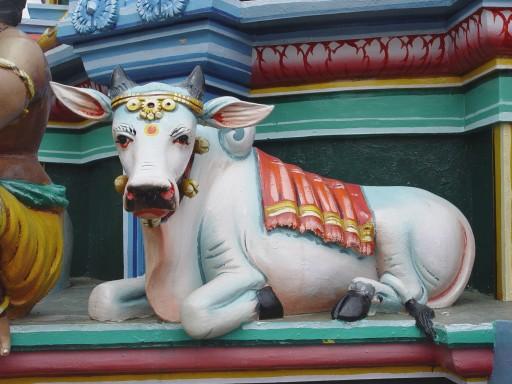
I really enjoyed Kipling’s argument criticizing Indian religion’s hypocritical love for animals. He points to Hindus “who would die sooner than eat flesh, but who would also rather die than touch or help a dying man of a low caste near his door.”[5] I wonder how someone can claim to be holy and righteous but shun creatures of his own race. Surely cruelty against humans is more pertinent than cruelty against animals. Some may argue differently, that the human is self-sufficient and an animal is not. But under the caste system, humans are not self-sufficient; they are restricted to the class into which they are born. This video provides an insight into the harsh treatment endured by these people. [6] In a sense, they become lower than animals in the minds of the upper classes. Kipling also points out the hypocrisy in the love and reverence for cows in the Hindu religion. These animals receive respect while others such as pigs are hated. A cow cannot stand as an example for animal rights when it is one of a few species that are well treated.

A sacred Hindu cow.[7]


[1] Course Packet, 991.

[2] CP, 994.

[3] CP 993.

[4] http://conservationfinance.files.wordpress.com/2006/10/church-attendance.jpg

[5] CP 995.

[6] http://youtube.com/results?search_query=hindu+caste&search_type=

[7] http://www.omkarananda-kamakshi.org/images/nandi%20at%20corners%201.jpg