Wednesday, February 27, 2008

Black Beauty, part 2

The second part of Black Beauty appears to be a social commentary. Black Beauty changes hands many times and the reader is exposed to several different owners, learning more about the injustices not only towards horses, but towards people of the lower classes as well. The people in power are mainly depicted as unsympathetic and greedy who leave the poor to fend for themselves. Examples included in the book point out that because the lower classes, such as the non-independent cab drivers, often have no choice but to overwork the horses. This section also continues on with theme of comparison through the different master for which Black Beauty works.

Sewell subtly begins her social commentary through metaphor “Men will go fast, and if one can’t keep up to the other horses, it is nothing but whip, whip, whip, all the time.”[1] Black Beauty refers here to zealous drivers, but this reference also alludes to the pressures of society which apply to the Victorian Era as well as to today. Society pushes people continually in the ongoing rat race; we must continue to work, work, work. For many people working night and day on a meager salary is often not enough to feed a family. We see this situation illustrated several times in the later chapters of Black Beauty. Under Mr. Barry’s care Black Beauty suffered because her groomsman, Filcher, stole her corn to feed his family. He could not keep up with the physiological demands of his family, perhaps a product of low wages, and he in turn made the horse suffer. The cab horses reveal most intense example of the pressure to make money. Seedy Sam appears to be cruel to his horses, whipping and overworking them, pushing the animals towards their own death. However, in his view, he has no choice. Unlike Jerry, Sam does not own his own cab or horse and must make enough profit to “first pay the master, and then to provide their own living.”[2] [3]British currency He believed that caring for your horse’s well-being was a luxury and that “you must put your wife and children before the horse”[4] I believe this is where the reader begins to understand that man does impose tough standards and treatments upon animals, and that these men are often under tough standards and treatments as well, created by individuals of their own species who happen to have more power. The Governor, who originally criticized Sam, realizes this depressing fact sympathizing “It is hard times for both man and beast, and who’s to mend it I don’t know.” [5] The butcher’s son again emphasizes this same pressure to perform from those above us. He wears out his horse in an effort to deliver meats to demanding customers on time.[6] Time is money Today we pen up animals for slaughter because it is more cost and time effective just like the cab drivers’ treatment of the horses. It is my belief that this problem pervades all eras; man is apt to step on those below him to achieve personal gain.

Sewell also criticizes the extravagant and selfish lifestyles of the upper classes. Jerry, a hard-working, honest man is waits outside on New Year’s Eve and almost dies because of the carelessness of two drunk, aristocratic party-goers. Additionally, when Jerry tries to help a poor woman to a free cab ride, two zealous voters grab her cab, demanding a ride.

Black Beauty reveals itself as not only a novel promoting sympathy towards animals, but sympathy towards life in general “whether they be man or beasts”[7]. Every person has the obligation to treat all life forms with respect, including standing up for the oppressed. “If we see cruelty or wrong that we have the power to stop, and yet do nothing, we make ourselves sharers in the guilt.”[8] I believe that Jerry is the ultimate hero in the novel. He not only treats Black Beauty with respect and love, but he works to improve the lives of others as well, from a woman on the street to a horse in the carriage behind him.


[1] Anna Sewell, Black Beauty (Hertfordshire: Wordsworth Editions, 1993), 122.

[2] Black Beauty, 161.

[3] http://www.warwickshire.gov.uk/Web/graphics/graphics.nsf/graphics/Moneysurvey/$file/money.gif

[4] Black Beauty, 163.

[5] Black Beauty, 163-164.

[6] http://psdblog.worldbank.org/photos/uncategorized/2007/10/12/time_is_money_3.jpg

[7] Black Beauty, 59.

[8] Black Beauty, 161.

Monday, February 25, 2008

Black Beauty Part 1

Black Beauty’s story strongly touched me as a reader. I have always considered myself sympathetic and compassionate but this book made me realize that, at times, I am unknowingly unsympathetic and uncompassionate. Sewell’s account chronicles the experiences of an oppressed animal by writing the story from the victim’s point of view. Reading this tale puts the reader into the horse’s “horse shoes” – sorry I could not resist the pun!

Black Beauty, as a character, provides the reader with great detail on his situation. The horse discusses issues of which a casual rider may not be aware. For example, the driver who rents out Black Beauty for the day has no idea that she has a rock in her foot or any comprehension of the consequences of his actions. [1] Enterprise Rental Car He treats the horse like a modern-day rental car, an object for which he paid for the day and no sympathy or respect for. When a reader discovers the situation from the animal’s point of view, as one does in Black Beauty, it becomes much easier to sympathize with his situation. When a person does not take the time to understand an animal’s side it is impossible to truly be compassionate. Instead, it becomes easy to abuse and write off the animal as an unimportant life form. Merrylegs sums this notion up when he criticizes the boys who overworked him during a play date. “They [boys] never think that a pony can get tired, or have any feelings.” [2] Instead of realizing that Merrylegs was a living creature with physical limits, they assumed he lived for their personal enjoyment.

The story reiterates this message of sympathizing with an animal’s circumstances revealing drastically different outcomes that result from sympathetic and unsympathetic masters. Black Beauty grows up in a land of liberty and plenty where he muses that he “used to lie beside my mother in the green, pleasant meadow at Farmer Grey’s.”[3] Sewell cleverly contrasts Black Beauty’s upbringing to that of Ginger’s. Ginger reluctantly left her mother at a young age and was ill broken-in by an overzealous master (well, his crazed son) who though of her only as “horse-flesh,”[4] an object to be used. Black Beauty enters into John Manly’s care as a calm and well-trained animal. His first master broke him in slowly and compassionately, with care. Interestingly enough, Black Beauty is able to reframe Ginger’s misanthropic paradigm. He tries to identify with Ginger’s plight, which is impossible, and instead offers her insight about how appreciate her life under John’s care, drawing from Black Beauty’s life experiences.

Not only do Black Beauty and Ginger serve as foils representing caring and negligent training, so do the horses’ treatment under John and then under the Earl and rental horse company. John understood his animals; he knew when they were happy, upset, hurt or apprehensive. Because John and the Master cared, the horses listened and were more effective work animals. The two men realized that “[God] had given animals knowledge which did not depend on reason” [5] This realization saved the men’s lives on the river trip when Black Beauty sensed that the bridge was broken. [6] A rickety bridge On the other side of the spectrum, at the Earl’s house, Black Beauty and Ginger were ill-treated and forced to wear bearing reins, simply for fashion. Then, instead of desiring to help his Master, Black Beauty felt tired, weak and irritable and “going out was a constant harass instead of a pleasure.”[7] In the end, Reuben, an irritable trainer, pushed the horse so hard that he caused his own death and the ruin of Black Beauty’s former.

Sewell asks through Black Beauty’s stream of consciousness “What right do they have to torment and disfigure God’s creatures?”[8] The first section of the book asks this question of the reader. Sewell exposes the evils associated with horse-rearing, illustrating man’s tendency to abuse all that God/Mother Nature gave humanity. Society pushes animals past their physical and emotional limits without considering the feelings of these living, breathing creatures. I was formerly unaware of the details of horse training. I simply rode horses at a friend’s ranch or camp. I was ignorantly unsympathetic to these beautiful animals. Sewell’s novel opened my eyes to the trials of horses, and consequently many other animals.


[1] http://images.google.com/imgres?imgurl=http://www.bnm.com/images/ent_wrap_2.jpg&imgrefurl=http://www.bnm.com/enterprise_nonairport.htm&h=113&w=200&sz=8&hl=en&start=4&sig2=qcdKE-MXwTE1qIpUMlO14w&um=1&tbnid=Jius8zpauQ0IjM:&tbnh=59&tbnw=104&ei=FoHDR9C_BKXWigG09ISWDA&prev=/images%3Fq%3Denterprise%2Brental%2Bcar%26um%3D1%26hl%3Den%26client%3Dfirefox-a%26rls%3Dorg.mozilla:en-US:official%26sa%3DG

[2] Anna Sewell, Black Beauty (Hertfordshire: Wordsworth Editions, 1993), 50.

[3] Black Beauty, 109.

[4] Black Beauty, 42.

[5] Black Beauty, 63.

[6] http://images.google.com/imgres?imgurl=http://farm1.static.flickr.com/130/332672531_0860bc75ae.jpg&imgrefurl=http://blogs.bootsnall.com/TravelRich/thai-sa-nook.html&h=500&w=375&sz=196&hl=en&start=7&sig2=gRP_DiqKf78r3hfu7_Hchg&um=1&tbnid=jP08-tzZ0re_aM:&tbnh=130&tbnw=98&ei=nIHDR7eLI5WIiwG28JnwCw&prev=/images%3Fq%3Drickety%2Bbridge%26um%3D1%26hl%3Den%26client%3Dfirefox-a%26rls%3Dorg.mozilla:en-US:official%26sa%3DG

[7] Black Beauty, 96.

[8] Black Beauty, 54-55.

Thursday, February 21, 2008

A Role Model to Humanity

Sophie Ryan

E375L

21 Feb 2008

A Role Model to Humanity

Charles Dickens is arguably one of the greatest and most well-known authors of the Victorian Era. The man is famous not only for his literary skill, but also for his political influence. Lee describes effective leadership as “depend[ing] first on one’s personal vision and then one’s leadership vision.”[1] Dickens did just this by presenting his own social criticisms through his writing, therefore educating the public and leading the masses to seek change. He turned an unfortunate childhood experience into a life-long crusade, using his own power and influence as a writer to help the poor and ameliorate the modern system of social justice. I look up to this author because his language was so powerful and he chose to use his powers to carry out the mission of equality. Today, in the twenty first century, we continue to fail to act against injustices. We are so caught up in our day-to-day lives that we forget about the people below us. Failure to act is a crime in itself. People like Dickens are even more important today because our society needs someone to remind each and everyone one of us about our moral responsibility to help others. He serves as a role model to us all in his quest to improve the lives of our peers.

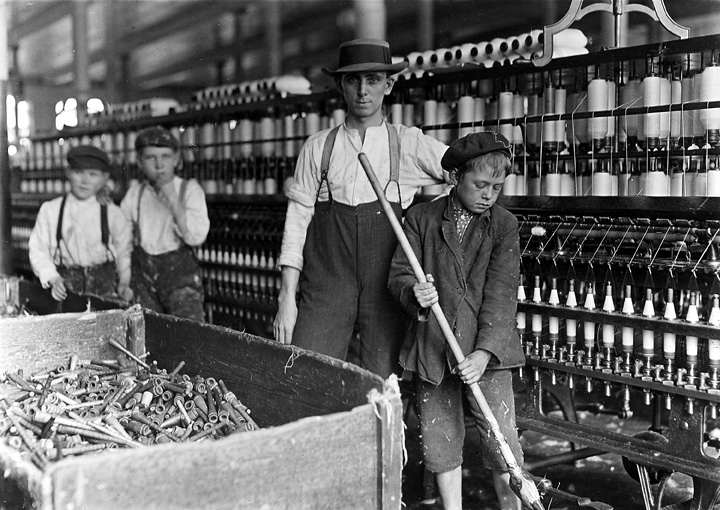
Life was not easy for Dickens. Following financial ruin in 1824, his father was thrown into debtor’s prison and Dickens, age twelve at the time, had no choice but to work in a ten-hour days in a boot-blacking factory like the one in the photo to support his family. It was during this time that the young author learned of the horrors of factory labor and prisons, two forces against which he wrote and spoke in his later life. “I had no advice, no counsel, no encouragement, no consolation, no assistance, no support, of any kind, from anyone, that I can call to mind, as I hope to go to heaven!"[2] These sentiments explain Dickens’ own plight during these years, expressed years later through one of his characters. Although Dickens experienced poverty at so young an age, he turned his terrifying experiences into a positive force that changed those unjust systems.

Child laborers at a cotton-mill[3]

Dickens’ transformation into a world leader is remarkable not only because he rose above his own dismal circumstances, but because he did so without any role model of his own whom he could follow. His father brought the family into debt and his mother was not much better, forcing her son into child labor, even after the author’s father was out of prison. Although Dickens did not receive much formal schooling, his childhood experiences educated him in life – an education which he passed onto all of his readers. His writing taught people to “respect, to consult, to aid each other. Thus is created a pure and clear atmosphere of thought, which the student also breathes.”[4] Dickens’ own views on education become apparent in Hard Times as he satirically describes an adamant school teacher who demands that the children be taught “nothing but Facts [sic] sir; nothing but Facts [sic]”[5] The author describes this teacher as monster who aims to “blow [the students] clean out of the regions of childhood at one discharge.”[6] Although Dickens received a meager education and had no role models himself, he did understand the necessity and value of a wholesome education – one in which the teacher strives to teach his students about the world around them not through useless facts, but through an understanding of others. Through his novels, plays, magazine and newspaper writings Dickens’ readers are able to grasp an understanding of their fellow man and the plight of individuals much different from themselves.

Readers quickly learned to love Dickens’ writings. His fame rose after his first installment of Pickwick Papers, a comical novel, in 1836 and his popular appeal was established. During this same year he composed two plays and a pamphlet advocating the poor’s participation in the Sabbath. Oliver Twist, published the following year, continued on Dickens’ theme of promotion of the financially unfortunate members of society. The story followed the experiences of a young boy, revealing the crime and destitution of the London slums. His story eventually led to the clearing out of the area. The author’s novel Hard Times highlig factory workers “So many hundred Hands [sic] in this Mill; [sic] so many hundred horse Steam Power.” (Course pack 275) A Christmas Carol has reached legendary status in today’s world, carrying over the Victorian ideal of social change for generations to come. The miserly Scrooge inspires children across each Christmas to remember those less fortunate than them and to share their own wealth. Dickens’ writings inspired social change on many different levels and over many years. The city of London changed its policies due to social outcry arising from the author’s works and individuals were forced to reevaluate their own situations as well. His ability to create dramatic change was incredible for one man.

Dickens grasped the injustices of the lower classes – those living in the slums, working in dingy factories and slaves in America – and he strived to imprhted the plight ofove their conditions. Each day we hear about uprisings and violence in the Middle East and famines in Africa. We see the homeless and suffering in our own country, yet so many of us fail to act. After Hurricane Katrina so many I know lost so unbearably much, yet much of America failed to act. I watched helplessly in Austin as my fellow New Orleanians struggled to find food, water and shelter. Today, two and a half years after the storm, I continue to drive through neighborhoods that remain utterly destroyed. I ask myself why this situation persists, I wonder why, outside of New Orleans, there has been little public outcry over the situation. Just as many of Dickens’ characters, much of the suffering in New Orleans has been forgotten.

I look up to Dickens as my Victorian role model because he continued to stand up for the needy and the downtrodden; those whom the world forgot. He amassed a fortune from his bestsellers but he continued to fight for the lowly. Now I ask myself what I can do to be more like Dickens. I may not possess his skill in writing, but I have other skills that will allow my voice to be heard to help remedy my home. Each time I return home I volunteer in flood-ridden areas. At school, in Austin where many people have forgotten, I continue to spread the word. One day I would like to run for public office, gaining the power to ask for more aid and use it wisely. Additionally, I need to become more aware of the world around me and strive to live my life in another’s shoes.

Homeless person on the street, like many on “The Drag.”[7]

So often we are too focused on our own troubles to realize the plights of those around us. Students walk down “The Drag” each day complaining about tests and boyfriends while our peers beg and sleep on the street at our feet. We walk by, compassionless and unaware of their plights like those of the woman pictured above. Charles Dickens was the man who forced the world to realize and comprehend existing injustices and aim to change them. He rose from a life of poverty into one of power. Not only is this achievement impressive in itself, but he also chose to use his power to create meaningful change, unlike many celebrities today. His books inspired the masses to change living standards of the day through social pressure. His legacy shines in the Victorian Era as the man who stood out from the crowd and demanded a better world from its inhabitants.

Word Count with Quotes: 1,321

Word Count w/o Quotes: 1,221


[1] Lee, Robert J. Discovering the Leader in You A Guide to Realizing Your Personal Leadership Potential, in Victorian Literature (Austin: Jenn’s, 2008), 78.

[2] Dickens, Charles 1849. “David Copperfield,” Web-Books, http://www.web-books.com/classics/dickens/david/David11_1.htm, 1.

[4] Newman. The Idea of a University, in Victorian Literature (Austin: Jenn’s, 2008), 309.

[5] Dickens, Charles. Hard Times, in , in Victorian Literature (Austin: Jenn’s, 2008), 272.

[6] Dickens, Charles. Hard Times, in , in Victorian Literature (Austin: Jenn’s, 2008), 273.

Wednesday, February 20, 2008

sympathy/compassion...forgotten in today's urban world

I am a city girl through-and-through. I grew up in a city and continue to live in one in Austin. I can find everything in a small area, nightlife abounds, cultures mix and truly, one can never be bored. Just as Hopkins’ “love for the city grows more ‘sweet-familiar” (course pack 633) so does my own as I grow older and learn to appreciate the dynamics of urban life.

[1] Woman on bike over looking a city

However, there are things that I dislike about large cities – the corruption of city life that is the suburb. I cannot agree more with Hopkins’ statement that “…ugly suburban expansion is portrayed as the product of commercial values which are inimical to the harmonious balance of town and nature.” (cp, 635) Suburbs, to me, are fake cities. They are simply extensions of a city which try to lay claim to a large and successful urban area while their inhabitants still “live in the country.” Cities are meant to be areas where land is sought after and where people live and work closely together; they promote the exchange of ideas, goods and services. The country is supposed to be a peaceful place, away from the smog of cities where its inhabitants can relax and enjoy nature. Often, people have two homes for both city and rural living. Suburbs take away the commercial aspect of a city and the environmentally-friendly aspect of life outside of cities, creating more traffic, aggravation, pollution and uniqueness.

[2] A joke about urban sprawl…cities keep encroaching on our natural resources!

As cities (and their suburbs) grow, they encroach further and further into the natural habitat of many plant and animal species without the least bit of sympathy towards these creatures. The people moving into KB home developments are not “affected by the suffering or sorrow of another” [3]

Hold on now, I am not removing all blame from inner-city dwellers. We live in urban environments removed from nature, and often forget where our food, clothing and supplies come from. Most of the meat we devour at five-star restaurants such as Smith and Wollensky in big cities comes from meat processing plants where animals are tortured before we eat them and use their products.

[4] Smith and Wollensky restaurant, Chicago

People today do not hold the same compassion for animals that people like Jude did because so many of us live in cities and suburbs, away from any farms or ranches. We do not possess the compassion Jude has for the pig he and Arabella kill. “Upon my soul I would sooner have gone without the pig than have had to do this!” laments Jude just before he kills the animal (Hardy, 53)[5]. “As we have no immediate experience of what other [animals] feel, we can form no idea of the manner in which they are affected, but by conceiving what we ourselves should feel in the like situation.”[6] For those of us living in cities, we are so removed from nature that we cannot begin to imagine and sympathize with Mother Nature. We lead lives today full of hustle and bustle where, unfortunately, we find little time to actually question what is given to us, and we accept the easiest way out.


[1] http://xtinacooke.files.wordpress.com/2007/10/woman-bike-overlook.jpg

[2] http://envplan240.pbwiki.com/f/carturbansprawl_wikipedia1_jpg.jpg

[3] http://www.cwrl.utexas.edu/~bump/sympathy.html

[4] http://lynnbecker.com/repeat/06christmas/20061222wollenskychristmas7.jpg

[5] Hardy, Jude the Obscure.( New York: Barnes and Noble Books)

[6] http://www.cwrl.utexas.edu/~bump/sympathetic%20imagination.html

Monday, February 18, 2008

Conversion

The Romantic Era came to a close transforming into the Age of Queen Victoria. The Romantic period promoted the spontaneous and imaginative, often as a feeling of “nostalgia (for childhood or the past).” (course pack, 599) This sentimental time yearned for a “return to a lost home or haven.” (course pack, 599) On the other hand, the Victorian Era doubted past suppositions and experiences such as religion, and favored invention and political change, bettering the situation of mankind. This sense of conversion is presented in Mill, Buckley and Carlyle’s writings. Mill and Carlyle “aspire towards spiritual fulfillment” (Buckley, 592) and look towards a greater happiness following times of depression or unhappiness. The two reach their goals through personal inquiry and investigation.

Buckley describes an Anglican priest’s description of conversion. The man states that conversion comes only from a “troubled soul beset with a liberating despair…and a passionate desire to find some new centre [sic] of life.” (Buckley, course pack, 595) Carlyle’s excerpt describes a man during a time of conversion, a painful time. However, the man finds his way out of this dark place only by locating the “inarticulate Self-consciousness [sic] [that] dwells dimly within us.” (Carlyle, Sartor Resartus, cp 606) Carlyle writes that someone can only overcome this self-consciousness by himself; we are, in a sense, our own enemy. “The fearful Unbelief [sic] is unbelief in yourself.” (Carlyle, cp 606) We shoot ourselves in the foot by living in fear of ourselves and our capabilities. [1]Man shooting himself in the foot

Instead, we must search for the “Everlasting” (Carlyle, cp 607) to overcome the dark in our lives. The “Everlasting” will provide us with truths, allowing man to live in peace and spiritual prosperity. There will always be a “black spot in our sunshine,” but once we can relate to a higher power these “black spots” will cease to bring man into despair (Carlyle, cp 608).

[2]Search for happiness

Mill’s conversion focused on the discovery of happiness. He learned that to become happy, one must not focus on the unhappiness in his life and strive for happiness, but excel in other areas of life. Like Buckley, he urges us to disregard the “black spot,” as this will only make the spot more obvious. Mill also explains that he began to focus on the “internal culture” of the individual, and ceased to bother himself with outside occurrences in order to create a happier environment (Mill, cp 694). His search for happiness finally ends with Wordsworth. Mill not only praises his pleasurable descriptions of nature (a Romantic theme), but the ways in which the poet describes nature that “expressed, not mere outward beauty, but states of feeling, and of thought colored by feeling, under the excitement of beauty.” (Mill, cp 695) These descriptions brought Mill to the realization that happiness lies in “tranquil contemplation” and an interest in the “common destiny of human beings.” (Mill, cp 695). Mill’s conclusions arising from his transformation point to the Victorian values of doubt and reactionism coupled with social improvement of mankind.


[1] http://www.danoconnor.com/images/golf/golf_cartoon_shoot_self_in_foot.jpg

[2] http://www.notsalmon.com/images/want_to_be_happy.gif

Wednesday, February 13, 2008

College Tests

Just twenty minutes ago, I hung up the phone with my childhood friend Sarah. Sarah was born the day after me and we have been best friends ever since. We have consoled, supported and enjoyed one another for the past twenty one years. So today, when Sarah called me it was no different. However, today’s call brought me immediately to Alice’s experiences in “Through the Looking Glass.”

Sarah telephoned me today for a “quick” vent session – really a 45 minute phone call – because she felt like all of her college friends had left her, she felt alone, confused and betrayed by her friends of two years. Sarah, like Alice, entered into an unknown. Sarah’s friend network from home was geographically absent and she was wandering around in her own dream-like Wonderland where she was unsure of whom or what to trust.

At college, most students are forced to break out of their own comfortable zone. Often we befriend people easily in the beginning, when friendships are low-commitment and based on an immediate mutual need for companionship. Over the years, we discover whom we can trust and with whom we are legitimately compatible and share interests. Fair-weathered friends drop away from our lives and true, strong friendships blossom. We learn through experience that as Emerson wrote “the only way to have a friend is to be one.”[1] Unfortunately, losing these initial friends is still painful and often hard to grasp, not matter who is at fault. Alice experienced this same phenomena in “Through the Looking Glass” when she lost her friend, the doe, in the wood where things have no names. As soon as the doe understood who he was, such as a young adult growing up in college, he quickly scampered off. Carroll describes this: “Alice stood looking after it, almost ready to cry with vexation at having lost her dear little fellow-traveler so suddenly.” [2] However, Alice regained her sense of self after she left the woods and exclaimed “that’s some comfort.”[3] Losing friends is painful as a student, but it is a part of the college experience and of becoming an adult. Just as Alice did, you mature and cherish what you do have.

[4] A girl consoling her friend.

Not only does the college experience simply test a student in terms of friendship, but in more general terms as well. The four (potentially more) years that are spent at college are unlike any experience that a student has gone through before. You are encouraged to try new things, and to often try things in ways you never thought possible or that make you uncomfortable. For instance, the thought of sharing a bedroom, dealing with someone else’s alarm clock and routine used to make me cringe. At first the adjustment was hard, but I got over it. Instead my roommate became a friend, someone who kept me from being lonely. We were never best friends, but we helped one another out. For example, my freshman year roommate had to decorate her cooler for OU weekend, it was the night before and she had not even started. However, we joined forces and created a great cooler in just a few hours!

[5] The Last Minute OU Cooler.


Next year I will have my own room for the first time since high school, and I have to admit I have mixed feelings. I will enjoy my independence but miss the constant companionship. Alice was faced with this same experience upon entering the looking glass. Everything was backwards and zany. For instance Alice exclaims “Living backwards! I never heard of such a thing!”[6] But she eventually adjusts to her new surroundings, even joining in on the Queen’s backwardness asking “When do you expect to [prick yourself]?”[7] and laughing afterwards.

[8] Girl riding backwards on horseback.

The college experience forces every one of us out of our comfort zone. We often open ourselves up to others only to be hurt by an untrustworthy person we consider a friend. But we also meat tons of new and interesting people by opening ourselves up. It is only by sacrificing a little that we gain the world.


[1] Emerson, Ralph Waldo. “Friendship.”, 1841.

[2] Lewis Carroll. The Annotated Alice, ed. Martin Gardner. New York, NY: Bramhall House (*no date given for publication). p227.

[3] Carroll, 227.

[4] http://images1.comstock.com/Imagewarehouse/TS/SITECS/NLWMCompingVersions/C0037/C0037101/C0037101.jpg

[5] Cooler photo from my files, October 2005.

[6] Carroll, 247.

[7] Carroll, 249.

[8] http://www.southalgonquincamp.com/photos/courtney%20backwards.jpg

Monday, February 11, 2008

A Student in Academia Land - with working photos

Most freshmen enter college with a false sense of confidence in their own understanding of themselves. They have just written a ton of college-entry essays describing their joys, fears and life goals and have just been accepted to college- YAY! However, many are in for a rude awakening. Once on campus, freshmen realize that they are no longer the top dogs that ruled high school and their futures do not appear as clear cut as they once did.

When I arrived in Austin in August of 2005, I was confident in my major and future. I was in the Business Honors Program and ready to take on the world. But I immediately felt overwhelmed, suddenly unsure of what I wanted to do with my life and searching for answers. Teachers threw out words like resume, career fair, interview and corporate internship. The University of Texas had just accepted me and now I was supposed to start preparing for applications again! Furthermore, other majors begin to interest me, but I was confounded unto which I should follow. I half-filled out applications for countless programs, took a myriad of odd classes and talked endlessly with advisors to discover what exactly I wanted to do with my life. I found myself relating to Alice as she says “I can’t understand it myself, to begin with; and being so many different sizes in a day is very confusing.”[1] One second I was one extreme – interested in anthropology – and another second thinking about applying to the School of Nursing.

A mini Alice.[2]

A large Alice. [3]

Thankfully, I found my path, or a path that legitimately suits my interests and goals. Today I am a double major with a minor. I know that I will never feel 100% complete with my academic choices as I did in high school, but it is almost impossible to pursue each and every interest at a University. I sometimes still contemplate different paths and regret not having pursued other interests but as Carroll describes it “It was so long since [Alice] had been anything near the right size, that it felt quite strange at first; but she got used to it.”[4]

Furthermore, I believe that there is a strong relationship between the freshman class experience and Alice’s experience at court. A first-year student often saunters into his first college class feeling fairly confident. Although it may be their first time in a college class, they recognize the classroom setting, the professor, the blackboard and other students. Older friends and siblings may also have told students about their college experiences. Carroll’s writing seamlessly alludes to this experience through Alice’s in the courtroom: “Alice had never been in a court of justice before, but she had read about them in books, and she was quite pleased to find that she knew the name of nearly everything there.”[5] But many are not ready for the reality check that awaits, such as Alice. Alice was caught off guard by the rabbit’s summons just as many first-year students are caught off guard by those nasty multiple choice tests.

A large university-sized classroom.[6]

Alice’s experiences in the far-off Wonderland are just as scary for her as a freshman’s entry into a large and daunting university. Just as she had to face a new world, so do hundreds of thousands of teenagers each fall.


[1] Lewis Carroll, The Annotated Alice, ed. Martin Gardner (New York, NY: Bramhall House*), 67-68.

[2] http://ecx.images-amazon.com/images/I/51AQZ1NC73L.jpg

[3] http://www.cartoonstock.com/lowres/csl2979l.jpg

[4] Carroll, 77.

[5] Carroll, 144.

[6] http://losingcontext.com/wp-content/uploads/2007/10/look-at-them-apples.jpg

A Student in Academia Land

Most freshmen enter college with a false sense of confidence in their own understanding of themselves. They have just written a ton of college-entry essays describing their joys, fears and life goals and have just been accepted to college- YAY! However, many are in for a rude awakening. Once on campus, freshmen realize that they are no longer the top dogs that ruled high school and their futures do not appear as clear cut as they once did.

When I arrived in Austin in August of 2005, I was confident in my major and future. I was in the Business Honors Program and ready to take on the world. But I immediately felt overwhelmed, suddenly unsure of what I wanted to do with my life and searching for answers. Teachers threw out words like resume, career fair, interview and corporate internship. The University of Texas had just accepted me and now I was supposed to start preparing for applications again! Furthermore, other majors begin to interest me, but I was confounded unto which I should follow. I half-filled out applications for countless programs, took a myriad of odd classes and talked endlessly with advisors to discover what exactly I wanted to do with my life. I found myself relating to Alice as she says “I can’t understand it myself, to begin with; and being so many different sizes in a day is very confusing.”[1] One second I was one extreme – interested in anthropology – and another second thinking about applying to the School of Nursing.

A mini Alice.[2]

A large Alice. [3]

Thankfully, I found my path, or a path that legitimately suits my interests and goals. Today I am a double major with a minor. I know that I will never feel 100% complete with my academic choices as I did in high school, but it is almost impossible to pursue each and every interest at a University. I sometimes still contemplate different paths and regret not having pursued other interests but as Carroll describes it “It was so long since [Alice] had been anything near the right size, that it felt quite strange at first; but she got used to it.”[4]

Furthermore, I believe that there is a strong relationship between the freshman class experience and Alice’s experience at court. A first-year student often saunters into his first college class feeling fairly confident. Although it may be their first time in a college class, they recognize the classroom setting, the professor, the blackboard and other students. Older friends and siblings may also have told students about their college experiences. Carroll’s writing seamlessly alludes to this experience through Alice’s in the courtroom: “Alice had never been in a court of justice before, but she had read about them in books, and she was quite pleased to find that she knew the name of nearly everything there.”[5] But many are not ready for the reality check that awaits, such as Alice. Alice was caught off guard by the rabbit’s summons just as many first-year students are caught off guard by those nasty multiple choice tests.

A large university-sized classroom.[6]

Alice’s experiences in the far-off Wonderland are just as scary for her as a freshman’s entry into a large and daunting university. Just as she had to face a new world, so do hundreds of thousands of teenagers each fall.


[1] Lewis Carroll, The Annotated Alice, ed. Martin Gardner (New York, NY: Bramhall House*), 67-68.

[2] http://ecx.images-amazon.com/images/I/51AQZ1NC73L.jpg

[3] http://www.cartoonstock.com/lowres/csl2979l.jpg

[4] Carroll, 77.

[5] Carroll, 144.

[6] http://losingcontext.com/wp-content/uploads/2007/10/look-at-them-apples.jpg