Sophie Ryan
E375L
21 Feb 2008
A Role Model to Humanity
Charles Dickens is arguably one of the greatest and most well-known authors of the Victorian Era. The man is famous not only for his literary skill, but also for his political influence. Lee describes effective leadership as “depend[ing] first on one’s personal vision and then one’s leadership vision.”[1] Dickens did just this by presenting his own social criticisms through his writing, therefore educating the public and leading the masses to seek change. He turned an unfortunate childhood experience into a life-long crusade, using his own power and influence as a writer to help the poor and ameliorate the modern system of social justice. I look up to this author because his language was so powerful and he chose to use his powers to carry out the mission of equality. Today, in the twenty first century, we continue to fail to act against injustices. We are so caught up in our day-to-day lives that we forget about the people below us. Failure to act is a crime in itself. People like Dickens are even more important today because our society needs someone to remind each and everyone one of us about our moral responsibility to help others. He serves as a role model to us all in his quest to improve the lives of our peers.
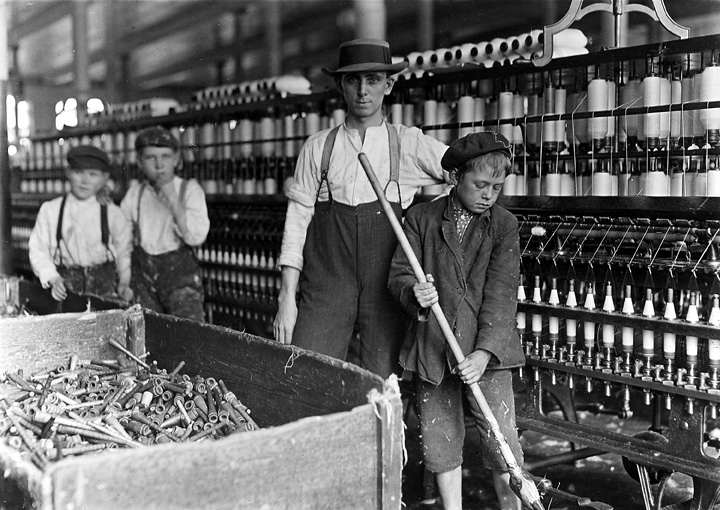
Life was not easy for Dickens. Following financial ruin in 1824, his father was thrown into debtor’s prison and Dickens, age twelve at the time, had no choice but to work in a ten-hour days in a boot-blacking factory like the one in the photo to support his family. It was during this time that the young author learned of the horrors of factory labor and prisons, two forces against which he wrote and spoke in his later life. “I had no advice, no counsel, no encouragement, no consolation, no assistance, no support, of any kind, from anyone, that I can call to mind, as I hope to go to heaven!"[2] These sentiments explain Dickens’ own plight during these years, expressed years later through one of his characters. Although Dickens experienced poverty at so young an age, he turned his terrifying experiences into a positive force that changed those unjust systems.
 Child laborers at a cotton-mill[3]
Dickens’ transformation into a world leader is remarkable not only because he rose above his own dismal circumstances, but because he did so without any role model of his own whom he could follow. His father brought the family into debt and his mother was not much better, forcing her son into child labor, even after the author’s father was out of prison. Although Dickens did not receive much formal schooling, his childhood experiences educated him in life – an education which he passed onto all of his readers. His writing taught people to “respect, to consult, to aid each other. Thus is created a pure and clear atmosphere of thought, which the student also breathes.”[4] Dickens’ own views on education become apparent in Hard Times as he satirically describes an adamant school teacher who demands that the children be taught “nothing but Facts [sic] sir; nothing but Facts [sic]”[5] The author describes this teacher as monster who aims to “blow [the students] clean out of the regions of childhood at one discharge.”[6] Although Dickens received a meager education and had no role models himself, he did understand the necessity and value of a wholesome education – one in which the teacher strives to teach his students about the world around them not through useless facts, but through an understanding of others. Through his novels, plays, magazine and newspaper writings Dickens’ readers are able to grasp an understanding of their fellow man and the plight of individuals much different from themselves.
Readers quickly learned to love Dickens’ writings. His fame rose after his first installment of Pickwick Papers, a comical novel, in 1836 and his popular appeal was established. During this same year he composed two plays and a pamphlet advocating the poor’s participation in the Sabbath. Oliver Twist, published the following year, continued on Dickens’ theme of promotion of the financially unfortunate members of society. The story followed the experiences of a young boy, revealing the crime and destitution of the
Dickens grasped the injustices of the lower classes – those living in the slums, working in dingy factories and slaves in
I look up to Dickens as my Victorian role model because he continued to stand up for the needy and the downtrodden; those whom the world forgot. He amassed a fortune from his bestsellers but he continued to fight for the lowly. Now I ask myself what I can do to be more like Dickens. I may not possess his skill in writing, but I have other skills that will allow my voice to be heard to help remedy my home. Each time I return home I volunteer in flood-ridden areas. At school, in
 Homeless person on the street, like many on “The Drag.”[7]
So often we are too focused on our own troubles to realize the plights of those around us. Students walk down “The Drag” each day complaining about tests and boyfriends while our peers beg and sleep on the street at our feet. We walk by, compassionless and unaware of their plights like those of the woman pictured above. Charles Dickens was the man who forced the world to realize and comprehend existing injustices and aim to change them. He rose from a life of poverty into one of power. Not only is this achievement impressive in itself, but he also chose to use his power to create meaningful change, unlike many celebrities today. His books inspired the masses to change living standards of the day through social pressure. His legacy shines in the Victorian Era as the man who stood out from the crowd and demanded a better world from its inhabitants.
Word Count with Quotes: 1,321
Word Count w/o Quotes: 1,221
[1] Lee, Robert J. Discovering the Leader in You A Guide to Realizing Your Personal Leadership Potential, in Victorian Literature (
[2] Dickens, Charles 1849. “David Copperfield,” Web-Books, http://www.web-books.com/classics/dickens/david/David11_1.htm, 1.
[3] Latin American Studies http://www.latinamericanstudies.org/ellis-island/cotton-mill.jpg, 1.
[4] Newman. The Idea of a University, in Victorian Literature (
[5] Dickens, Charles. Hard Times, in , in Victorian Literature (
[6] Dickens, Charles. Hard Times, in , in Victorian Literature (
[7] Phillip’s Blog http://images.google.com/imgres?imgurl=http://phillips.blogs.com/photos/uncategorized/2007/03/29/329homeless2.jpg&imgrefurl=http://phillips.blogs.com/goc/2007/03/index.html&h=342&w=640&sz=74&hl=en&start=8&um=1&tbnid=lo0Hl_fZ1T6y_M:&tbnh=73&tbnw=137&prev=/images%3Fq%3Dhomeless%26um%3D1%26hl%3Den%26sa%3DN, 1.


No comments:
Post a Comment